Showing posts with label food not lawns. Show all posts
Wednesday, March 23, 2022
Starting Plants Indoors, 2022
Tuesday, May 25, 2021
The Easiest Vegetable Garden Ever, Part 3: Watering, Weeding, and Fertilizing
So, you built (or bought) some great soil, and you chose what to grow and planted it. Now what? Maintenance! If you're looking for a good harvest, you have to care for your garden consistently. Plants are like us: they need water and food. Unlike us, though, they can't run away when another plant is invading their personal space and sucking up resources, so it's your job to give them some room by removing weeds.
Wednesday, November 25, 2020
The Easiest Vegetable Garden Ever, Part One: Dirt
Wednesday, May 13, 2020
Homestead Update 5/13/20: Wave After Wave of Foliage
The April-to-May transition is one of the most stunning in St. Louis. Despite unseasonably cool weather (including two frost warnings), the garden, in the words of farmer and poet Wendell Berry, ‘Like a tide it comes in/wave after wave of foliage and fruit/the nurtured and the wild".
Sunday, April 19, 2020
Our Yard: Late March vs. Mid April 2020
The garden is really taken off now! The last frost is past, warmer weather is here, and rain is on the way. Here's how the yard has changed over the past couple weeks (and look for a full homestead update tomorrow!).
First, the backyard:
Saturday, March 28, 2020
Homestead Update 3/28/2020: Spring Is Not Quarantined
![]() |
| The kale is a-growin'! |
I don't have to tell you it's been a crazy month. The whole global pandemic thing is not only causing death and throwing a serious wrench in everyone's plans, but stirring up a giant cloud of anxiety and helplessness and paralysis that often feels suffocating. All too often I find myself glued to social media, willing my stress and anxiety to make things better.
![]() |
| Nectarine blossoms— our tree was covered in all sorts of bees and wasps today! |
Fortunately, though, my garden has other plans for me. More than ever, I've been struck by what an incredible privilege it is to have a bit of earth to garden. A place to grow food, a place to play in the dirt, a place to sit and watch birds picking at my compost pile and squirrels digging holes in my garden beds. Our fruit trees are green with buds, and the nectarine tree has unfurled pink blossoms. The elderberry is sending up shoots. I'm finding mint poking up several yards from where I planted it. Our stinging nettle (a tasty wild green) has propagated itself all along our side yard. Our little suburban homestead is bursting with abundance, even with very minimal tending, and I don't think I've ever been more grateful for that.
![]() |
| Elderberry |
Yesterday I gave a snapshot of what our backyard looks like, so today I thought I'd start with a quick panorama of our front yard. We have big plans for this lovely patch of earth!
![]() |
| Empty garden bed (still need to figure out what to do with it) with an asparagus bed at the end. Chives are growing nicely! See next photo to hear about the very green grass... |
![]() |
| The northern side of our yard, with our hardy fig, lots of volunteer kale, a smattering of spring greens, and two hazels. |
![]() |
| Our elderberry and strawberry bed |
Other things we've been up to…
Digging a pond
Zach has been wanting to make a pond in our yard for multiple years now ("But where will I grow my tomaaaaaatoes?!" I've been whining), and a couple weeks ago, he finally dug one in the southeast corner of our backyard! It took him a couple hours and he hit some sort of water pipe (even though the utility guys didn't mark anything there), but we now have a pond-in-progress! We decided against using a plastic pond liner, and Zach's been experimenting with using clay to seal it off, with limited success. In the meantime, we're running rainwater from our garage roof into the pond, and will be getting some water plants soon to fill in the edges. I'm excited to see how the biodiversity in our yard will increase when this is up and running!


Spring crops!
My spring crops have sprouted, and some of them are getting tiny true leaves— maybe I'll be eating some fresh chard, spinach, carrots, and radishes soon! In the meantime, I'm making good use of the perennial greens: kale (which survived the winter), dandelion, violet leaves, clover, and henbit have all made their way into my pesto this week, and soon I'll be able to harvest plantain, stinging nettle, and (hopefully) asparagus. We're hoping to add more perennial crops to our garden this year, but they are surprisingly hard to find online, and the shipping is very expensive. So we're trying to figure out another source. (If you happen to know where I can buy sea kale, skirret, perpetual sorrel, Turkish rocket, or Good King Henry, please let me know!)
![]() |
| A polyculture in between the clover: some mixture of kale, radish, spinach, chards, and peas |
![]() |
| Spearmint emerging from its slumber! |
![]() |
| Comfrey, an important mulch/biomass plant, is coming up nicely in several places. |
![]() |
| Stinging nettle— the cooked greens taste like spinach and are waaaay easier to grow! |
Indoor summer seedlings
Our seedlings indoors have really taken off— tomatoes, peppers, flowers, valerian, lovage, St. John's Wort, tomatillos, sweet potatoes, and a few others are making good progress! Some we'll plant as soon as the last frost is over, while others (such as the tomatoes) will need to wait until early- to mid-May. I've been growing them in 4" pots— I've tried growing them in smaller cells, and I had to repot them halfway through, not to mention that they dry out and die much more easily. But growing them in the larger pots seems to be working well so far!
Propagating plants
I've been trying my hand at dividing some of my perennials to plant elsewhere/give away. So far I've tried stonecrop sedum, oregano, thyme, and mint: I just dug up some of the roots, pulled them apart, and stuck them in moist soil. We'll see if any of them survive.
What have you been up to lately?
~~~
Friday, March 27, 2020
Our Yard: Early March vs. Late March 2020
(To see last year's garden, check out this post!)
I thought it would be fun to post pictures of our garden in progress— thanks to mild weather and lots of rain, March has been an amazing growing season for us so far! It's wonderful to see how much the yard has grown in just a few short weeks. I'll be posting a full homestead update tomorrow, but in the meantime, enjoy!
P.S. If you're interested in learning more about any of these plants, or gardening/permaculture in general, please don't hesitate to leave a comment. I'm not an expert but I'm slowly gaining experience, so I want to be as helpful as I can!
I thought it would be fun to post pictures of our garden in progress— thanks to mild weather and lots of rain, March has been an amazing growing season for us so far! It's wonderful to see how much the yard has grown in just a few short weeks. I'll be posting a full homestead update tomorrow, but in the meantime, enjoy!
P.S. If you're interested in learning more about any of these plants, or gardening/permaculture in general, please don't hesitate to leave a comment. I'm not an expert but I'm slowly gaining experience, so I want to be as helpful as I can!
![]() |
| March 1st: Our cherry, elderberry, and false indigo trees, with raspberries in the foreground and the mulberry to the far right |
![]() |
| March 27th: Look at all that lovely clover! You can also see comfrey coming up. |
![]() |
| March 1st: Mulberry, hazel, and pear trees. Our old chicken coop still had Jerusalem artichoke stalks in it |
![]() |
| March 1st: Pear trees, false indigo, apple |
![]() |
| March 1st again |
![]() |
| March 27th: Bulbs along the fenceline are up (not sure what they are, they never bloom), and some comfrey and mint are coming up! |
Thursday, December 13, 2018
Homestead Update 12/13/18: Just All the Orange Vegetables
Stuff that’s been going on in our homestead...
The Monster Orange Vegetable Harvest.
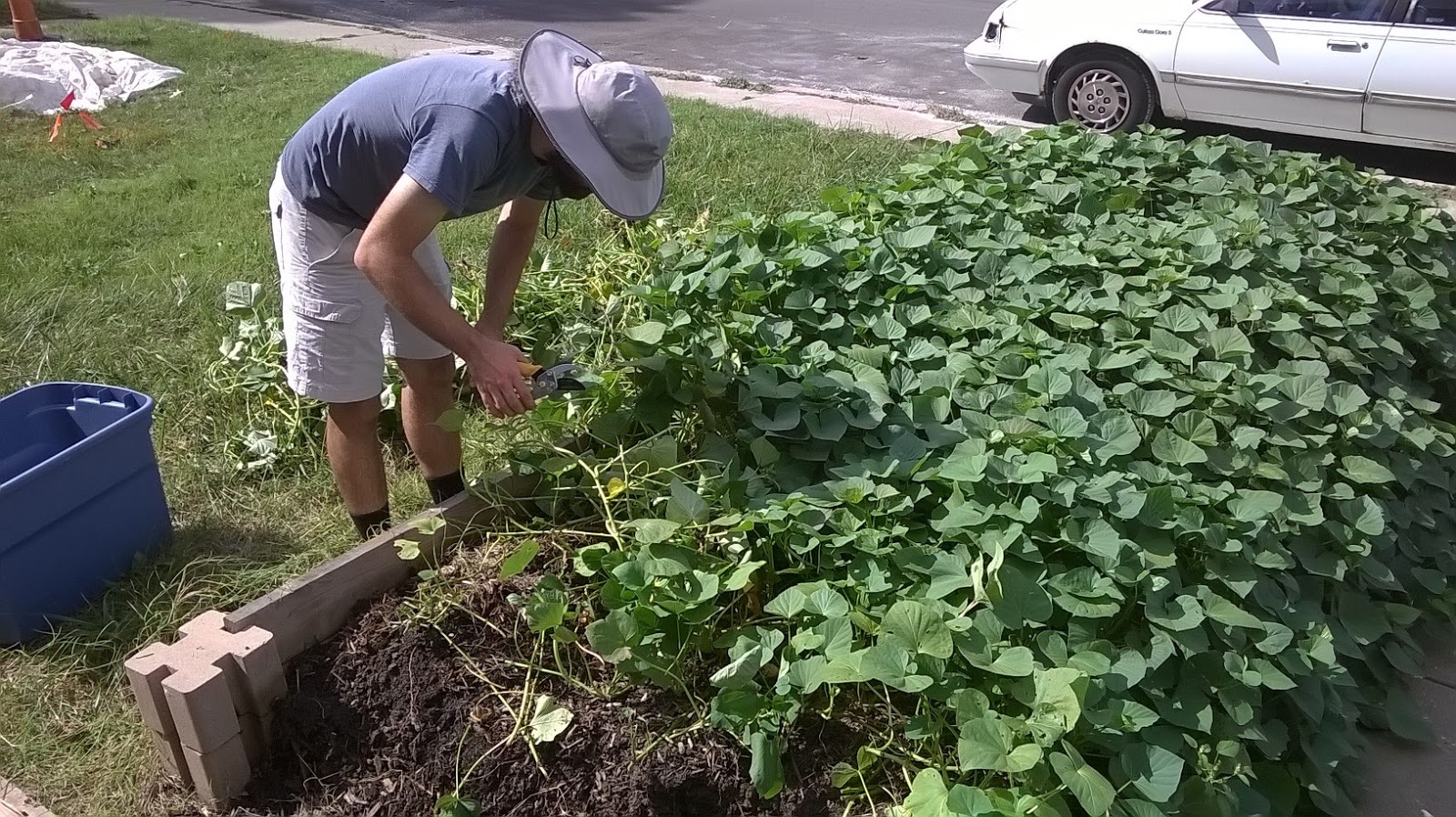
Zach and I officially have enough orange vegetables stored away to give us Vitamin A poisoning by the end of winter. Our butternut squash plants, despite being attacked by hordes of white squash bugs and every disease known to mankind, produced over a hundred pounds. Zach and I also learned that sweet potatoes are an AMAZING crop for the St. Louis area. Even when it hardly rained and was stupidly hot for weeks on end, I barely watered them. They just grew like weeds. We planted some very late in the season (late June), and they still grew huge tubers. The bugs hardly touched them. Weeds couldn’t compete with them. It was magic! Between the 4x10 bed in the front yard and a few random plantings around, we picked 120 pounds of sweet potatoes before the first frost.
Monster harvests of other crops.
![]() |
| Daikon radish, tomatoes, beans, sweet potatoes |
The Great Chickie Molt.
In early November, our chickens started losing their feathers, in response to the shortening days and the onset of winter. They looked incredibly scruffy for several weeks, but now they’re fluffily svelte again (except Izbushka, who is still pretty scraggly). They aren’t laying eggs at the moment, but I’m hoping they’ll lay at least a few more during the winter.
And finally... drumroll, please... I made pumpkin pie for Thanksgiving out of the pumpkins I grew in my own yard. I feel like my homesteading cred raised a solid point just for that. Sadly, the pumpkins weren’t as prolific as other orange veggies... but you can bet that there’s a lot of butternut squash and sweet potato pie in our future!
~~~
Saturday, November 10, 2018
How to Murder a Lawn: The Scintillating Sequel
![]() |
| For the record, that "Grateful Thankful Blessed"-style shirt I'm wearing is my Halloween cast shirt, which says "Lose your head to the Queen of Hearts." I don't wear that font unless murder is involved. |
Ever since Zach and I murdered our backyard lawn in February, the question has hovered over us: When would the front lawn meet its demise? Aside from the construction of a 5’x12’ sweet potato bed in May, we bided our time, waiting, as Jack Sparrow would say, “for the opportune moment.”
That moment came in early October, when my parents and their neighbor were having a couple trees taken down in their yards. Mom asked the contractor what he was doing with the wood chips, and later that afternoon we got a call from the guy asking where we wanted them dropped off. Within the hour he had dumped about fifteen cubic yards of freshly-chipped wood and leaves alongside our house— a value of at least $400, for free! (He left his business card, too, saying he’d be happy to drop off chips anytime. I feel like I’ve won the jackpot!)
We weren’t able to completely finish the yard, due to our square foot gardens still having veggies in them. After the greens die (which will be a while yet; kale and chard are hardy), we’re going to pull up the square foot gardens and remove the weed cloth underneath them, using biodegradable cardboard instead. But, for the most part, the yard is finished.
Even though the city’s Community Development truck drove veeery slowly past our house the first day, no one’s hassled us about it, and I’m hoping in the spring to plant a cornucopia of flowers, herbs, and veggies that will beat a boring ol’ lawn any day. In the meantime, I’m excited that we’re continuing to expand our permaculture dreams into the front yard, where all the world can (hopefully) see the beauty and joy of growing your own food.
~~~
Friday, May 11, 2018
A Visit to the Baker Creek Spring Planting Festival
![]() |
| The seed store at the very end of the day— it was much more crowded earlier! |
A while back, Zach and I decided that we wanted to check out a spring festival hosted at the Baker Creek Heirloom Seed Company headquarters down in the Ozarks. The day finally arrived last weekend, and we packed up our car with camping gear and a glut of snacks, then hit the road.
![]() |
| Zach doesn't like me taking his picture... |
The Spring Planting Festival is a place to celebrate heirloom ideals, most prominently in plants, but also in music, culture, and ideology. What defines an heirloom plant is debated, but it’s generally agreed that they are plants that breed “true to type,” unlike hybrids, which don’t have seeds that reliably grow into the same plant. More importantly, heirlooms are not patented. People maintain and propagate heirlooms with the idea that seeds and plants are everyone’s property— not a product that can be trademarked. Unique heirloom breeds are not only well-adapted to their specific regions, but they tell an important story about the people and culture of particular places. A sense of place is quickly being lost in modern culture, and so heirloom plants represent a whole ideology that encompasses every aspect of life.
After several hours of driving deeper into the rolling “mountains” of the Ozarks, we pulled up onto a multi-acre field that had been converted into a parking lot, stuffed full of cars. The hills rose up around us, intermittently wooded and pastoral, and on the hill in front of us we could see the festival entrance, rows of dozens of vendors, a big tent for the speakers, and a collection of buildings— a “pioneer village”— that Baker Creek maintains for visitors. We paid $5 each at the door and were swept inside into a dizzying array of people.
As with the Mother Earth News Fair, I was delighted with the variety of people I saw. People who care about heirloom plants do not fall into political party lines, which I love. Folks of all ages ran about: whole families in elaborate pioneer costumes (there had been a contest earlier that day), young mothers with dreadlocks and flowy skirts, teenagers with 4-H shirts, serious-looking men pushing strollers, middle-aged people asking detailed questions about the items being sold at the booths, young guys in overalls toting various bluegrass instruments, a lot of homeschoolers, and countless people wearing some version of a “March Against Monsanto” slogan.
We wandered by the booths that sold every conceivable breed of tomato, esoteric vegetables, hand-smithed garden tools, organic chicken feed, native perennials, herbal concoctions, solar panels, goat milk soap, chili served from a huge iron cauldron hanging over a fire, homemade pie, and everything in between. The speaker tent had a schedule posted out front, and another building hosted a line-up of bluegrass and country bands. Animal pens were scattered all around, housing geese, peacocks, exotic pheasants, ponies, goats, and a dozen rare breeds of chicken (chickens and other livestock can be heirloom, too!). In the “old-timey” village, we shouldered between people to peruse the seed store, with rows upon rows of Baker Creek offerings. Huge queues trailed out from a sandwich stand and the on-site vegan restaurant. We munched on trail mix, determined to save our money for plants.
After touring the vendor booths, we bought a peppermint plant (I killed my last one), a plastic cup of sweet potato slips, and a small start of sea kale, which is a perennial vegetable whose various parts can be eaten like asparagus, kale/collards, and broccoli. Then we headed to the speaker tent.
We listened to two different hour-long lectures. The first speaker was talking about his work at the Roughwood Seed Collection, a seed bank that specializes in rare heirlooms from the Eastern United States, particularly Pennsylvania.
![]() |
| Some of the heirloom corn on display in the Seed Store |
The next speaker was Raphael Mier, the head of the Fundación de Tortilla in Mexico, a non-profit dedicated to preserving heirloom corn, traditionally-made tortillas, and the stories and cultures bound up in both. In halting but precise English, he discussed why corn is so foundational to Central and North America— the civilizations of the Americas are founded on this grain.
To preserve heirloom corn— Mexico alone has several thousand unique varieties— is to preserve stories. Mier encouraged us as Americans to seek out U.S. heirloom corn, even though he warned that it would be harder for us since GMO corn is legal here, unlike Mexico. (Corn pollinates with everything so it’s very hard to grow true heirloom corn here, especially in this part of Missouri!). Listening to his appeal to “Fight for a better tortilla” made me feel a bit more grounded in the land, and more excited about engaging with this story that I hadn’t considered before. (After we got home, Zach bought some corn flour and we made our own tortillas— very time-consuming, but delicious!)
After that lecture, we bought a few more plants: some strawberries, a vining heat-loving plant called Malabar spinach, and a Chicago hardy fig. Then we stood in the “town square” to wait for the last event of the day, a tour of Baker Creek’s greenhouse and warehouse.
First our guides took us to a greenhouse that the owners of Baker Creek, the Gettle family, keep for their own pet projects. The huge greenhouse was resplendent with banana trees, pawpaw, taro, and all sorts of other edibles. Week-old heirloom chickens scratched about in the mulch, and tall raised beds along the edges were home to beets and carrots grown for size competitions. The biggest beet was five feet long and still growing!
![]() |
| Monster beets! |
![]() |
| The view from the backside of the farm |
After that we got a tour of the seed warehouse. Baker Creek sells almost 2,000 different kinds of seeds, and they work with growers (both small- and large-scale) all over the country, aggregating their seeds to sell under one label. Our guide showed the sorting system and talked about how the company has evolved over the years, from a 17-year-old homeschool kid packing seeds on his mom’s kitchen table, to this giant warehouse where they fill 3,000 orders a day during their busy season. Despite the size, they remain committed to their original values, providing a hub to give the maximum number of people access to all sorts of rare seeds. It was very inspiring!
After the tour, Zach and I headed out among vendors packing up and people trickling back to their cars. We spent the night at a nearby RV park. In the morning, we drove to the Mansfield cemetery and saw the gravesite of Laura Ingalls Wilder and her family. After paying our respects, we headed home to build a bed for our sweet potatoes.
We came back with some wonderful fruits and vegetables to plant in the ground, but my biggest takeaway from the event was the sense of how plants, culture, stories, and a sense of place are all bound together, deepening my appreciation for the importance of growing food. I can’t wait for next year!
~~~
Tuesday, February 20, 2018
How to Murder a Lawn in Five Simple Steps
![]() |
| Zach works on Step Four while the chickens (and neighbors) wonder what the heck we're up to |
Last week, we murdered our backyard lawn by smothering it.
Now, I know what you’re thinking: “Lisa, why on earth would you want to get rid of your beautiful green lawn that requires little care and maintenance, when so many people in the world want to grow a nice lawn but can’t?”
Privilege. Midwestern river-bottom-soil full-sun suburban yard privilege.
And also because...
1. We are going to plant a bunch of fruit trees, and we don’t want the grass competing. Sapling roots and grass roots occupy the same space in the ground, so we want to give our little trees the best chance.
2. We want to plant tomatoes and squash, and smothering a lawn is a lot easier than double-digging a bed. Instead of breaking our backs hoeing up the ground, we just break our backs once hauling in mulch. In the summer we’ll plant the seeds/seedlings into little pockets of soil in the mulch.
3. We want to grow chicken forage/cover crops. Although chickens will eat grass, there are a bazillion other crops that are more nutritious and have flowers for the bees and nitrogen-fixing properties. It will be easier to sow these crops into mulch/soil rather than trying to hoe up the grass.
4. We want to preserve our reputation as the neighborhood weirdos.
The technique we chose, known as “sheet-mulching,” involves putting down a thick layer of cardboard (much more eco-friendly than weed cloth) and organic material in order to smother what you don’t want to grow. Eventually, time, weather, microorganisms, and the rotted remains of the lawn will break the materials into rich soil suitable for growing all sorts of delicious food. I’ve done mini-sheet-mulching before in our asparagus bed, but a whole backyard was a project on a much bigger scale. I’m pretty darn pleased with the results.
Here’s how we did it.
![]() |
| Tape peelings |
Step one: Gather more cardboard than you could ever possibly imagine.
A few months ago, Zach started making rounds at Walmart after he got off work, gathering cardboard boxes from the stockers (ask a manager or any employee if you can have some. I’ve also heard of people asking large-appliance stores and bike shops for their boxes). A pile of cardboard steadily grew in our garage.
As we neared our date for killing the lawn, we spent a whole evening dragging cardboard into our warm house (it was freezing in the garage) and tearing off all the plastic labels and tape. As I peeled, Zach counted the boxes and made rough calculations. It looked like one more load of cardboard would do the trick. After that evening, we had transferred a pile of plastic-free cardboard to the basement, waiting for the next step.
Step two: Find a source of mulch (or any kind of weed-free organic material).
This turned out to be tricky. People online and in gardening books always talk about how tree-trimming companies will give you mulch for free if you just call them, but the few leads I chased turned up nothing. At last, we settled on buying mulch instead, from R. Schroeder Sod Farm down the road. It looked like pretty low-grade mulch, which is exactly what we wanted because we want it to break down quickly. It was only $15 a cubic yard, much cheaper than anywhere else I’d called. Since the somewhat-hefty delivery fee was the same regardless, we ordered the maximum single delivery, which was 14 cubic yards, or enough to cover most of the yard in several inches. It was almost time.
Step three: Cover the yard in organic material.
You’re supposed to lay a bunch of high-nitrogen material down first, like grass clippings, but since it’s winter we were in short supply of green stuff. We settled for a layer of autumn leaves, gathered from my parents’ house. This would encourage worms and other microorganisms to take interest in the underside of our sheet mulch. It felt weird to dump leaves all over our lawn, making it look like an un-raked yard in autumn. But the chickens loved it!
Step four: Layer cardboard over everything.
On the day of our big project, it was time to add the cardboard layer. We began by soaking the ground with a hose, then laying out the cardboard, trying to overlap the edges so that weeds won’t be able to sneak through. We had to spray the cardboard frequently to keep it from drying and curling up in the sunlight. Our mountain of cardboard turned out to be enough to cover the entire backyard (minus the chicken coop), with some left over!
Step five: Add and spread the mulch.
The delivery truck showed up at noon on the dot, and dumped a massive pile of finely-ground mulch next to our yard, blocking half the street. Zach and I grabbed shovels and tote bins (lacking a wheelbarrow) and set to work, shovelful by shovelful. We worked for an hour non-stop, then my brother Christian joined us, him shoveling and us carrying tote bins, for another couple hours. My arms and back ached and I started grunting louder and louder with each load, but at long last we had covered the whole backyard with several inches of mulch.
Next, we leveled the mulch with garden rakes, turning the chickens out to help us (they didn’t). We left some mulch in a pile at the edge of the yard, for use on later projects, and smoothed out the rest as much as we could.
Our yard now looks somewhat naked, with its smooth carpet of blackish-brown mulch. But if I squint at the blank canvas, I see a utopia of fruit trees, nut trees, veggies, herbs, and cover crops. It’s hard to wait until spring!
And there you have it— five simple steps to murdering your lawn!
~~~
Subscribe to:
Posts (Atom)