Tuesday, January 10, 2012

An Excursion for Fish, History, and Pizza

1/9/2012
The Pine Knoll Shores Aquarium was good when I was a kid, but now it’s great. As I mentioned yesterday, the aquarium features a range of North Carolina native creatures, from the mountain streams of the west to the offshore ecosystems of the Outer Banks. When the four of us arrived around noon, we found the parking lot nearly deserted, which promised a much more relaxed experience than we ever got in summer or spring.
We read about mountain streams and the creatures that inhabit them, playing “find the frogs” in the little tanks, and ended up by the large river otter tank, which gave underwater views of these sleek mammals. On land they walk with a ridiculous bobbing, as if their midsections are too long for their legs, but once they jump in the water they transform into creatures of superb grace, slipping through the water in a flurry of silver bubbles. One of the three otters loved swimming upside down, flipping himself over with a kick of his back paws before diving to the bottom. We watched them for a good half hour before moving on.
The journey of water continued— from mountain streams to estuaries, grass flats, and saltwater marshes. We took a brief detour to walk outside and view some of the surrounding nature area. The water, at low tide, exposed the mud and tidal grass down to its roots. A few snowy egrets perched on the dead trees nearby, and we watched the tiny minnows swimming in the inches-deep water. Chased inside by the cold, we continued our journey.
Another highlight was the stingray and guitarfish petting area. The last time I had been there, it was a crowded August day, and the poor rays were clustered to the inner part of the tank, buried in the sand, begging with every ounce of their flat-fish bodies that the tourists would go away. Today, however, they swam freely, swooping by to investigate our hands. One of them even took a liking to Ryan. I have always been fascinated by rays, and I took a special interest into the guitarfish, who looked like a sandy, mottled fish that had been run over with a steamroller. They felt bumpy to the touch, while the rays felt smooth to the point of slimy. We chatted with the keeper, who told us that rays have an excellent sense of sight. I crouched down by the glass and looked one in the eye. I wondered how he perceived me, and if I was as fascinating to him as he was to me. 
We also got the chance to pet some horseshoe crabs, creatures of another eon, as well as hermit crabs and whelks. Fascinated, we looked at the displays of seahorses, pipefish, reef-fish and jellies. In good time, we reached the 306,000-gallon tank with the 65-foot-long viewing window. The water alone weighs over two million pounds, and a keeper informed us that there are over 800 creatures in the tank. We sat and watched the schools of fish the size of my torso, the clusters of smaller fish darting in and out, and the massive sharks— nurse with their tiny blank eyes and sand tigers with their open-mouthed stare and protruding teeth— drifting through. A green moray eel, six feet long, lurked in a corner and snaked out occasionally with mouth agape to impress the visitors. After a few minutes, we were surprised to see three divers enter the tank, floating in among the sharks to check… something (we never did figure out what). They waved at us, and Ryan played a game of paper-scissors-rock with one.

From the massive tank, we moved to displays highlighting the life on the miniature reefs that form on wrecks and piers (North Carolina’s coast is too sandy to support a true coral reef). I watched some jellyfish, fascinated by their tentacles, thin as strands of melted cheese. It looked as if the slightest touch could break them, yet these creatures— with no brain or heart— withstand the power of the ocean. 
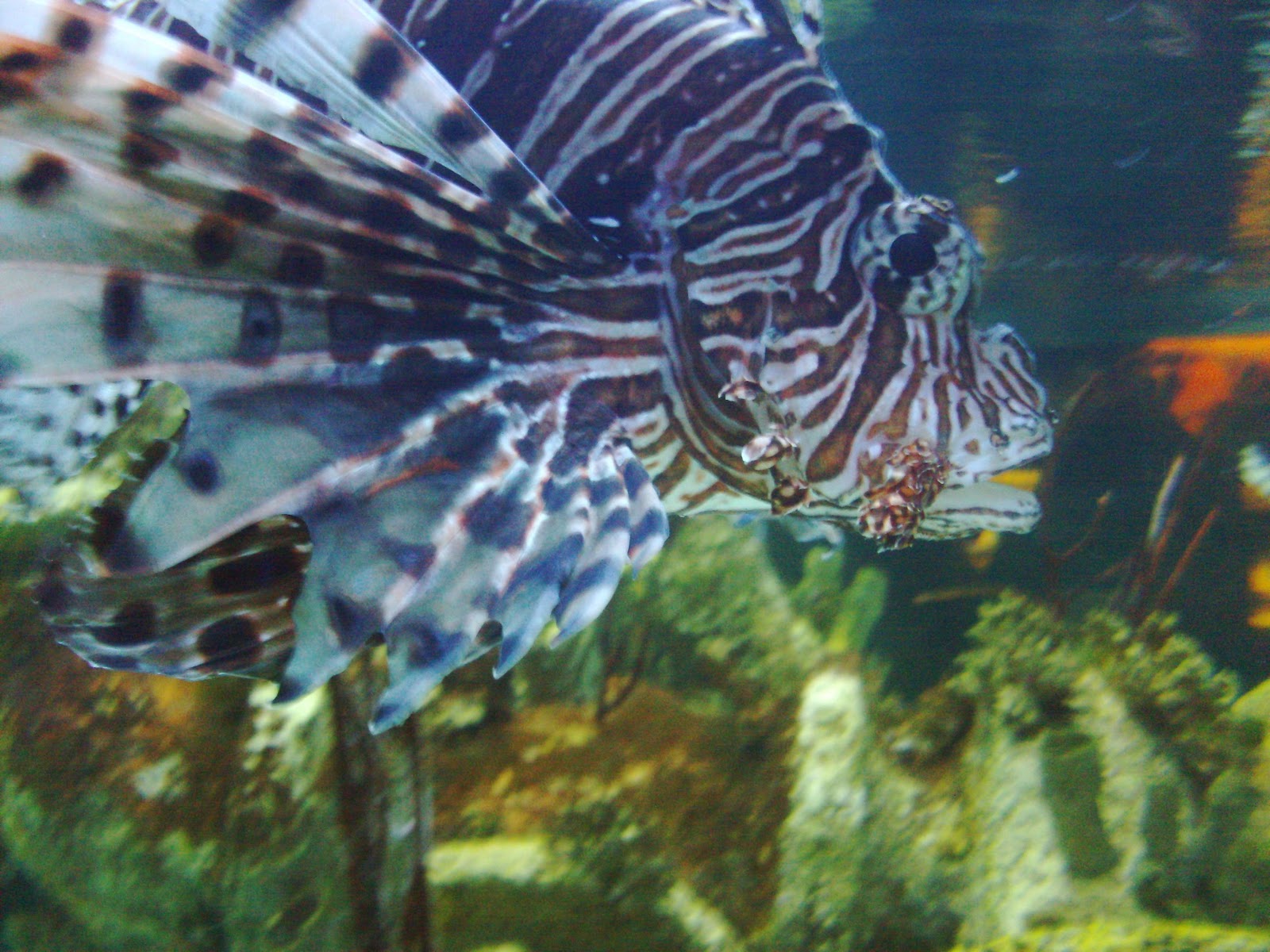
Next I turned to admire a display featuring five lionfish, venomous fish with leafy fins and tiger-like stripes (was the name “tigerfish” already taken?). I followed one around the circular tank, watching his fins, intricate as leaves, move the water to let him propel forward. The delicate movement of his gills fascinated me. Mary came up beside me and I started to say, “They’re so beautiful.” As I spoke, the lionfish’s tail fin drifted right past my eyes. I caught every detail of that moment: the fine brown ribs, the translucent webbing as delicate as spiderweb, the dark spots like drops of acrylic. My last word choked, and I felt a sob of joy rising in my throat. Just yesterday, I had been sad that I don’t feel things as deeply as I used to. But joy comes at unexpected moments, even in lionfish fins.

~


I didn’t want to go to Fort Macon. It was raining, and as far as I remembered, there was nothing to the fort except a shell of a brick building in the earth with nowhere warm or dry to sit. But I was outvoted three to one, and it’s a good thing I was. Not only was the fort full of indoor rooms with heating (I had forgotten the fort was closed last time we visited), but also contained interpretive displays, informational plaques, several creepy mannequins in Civil War uniforms, audio monologues about history and everyday life, and a video about the fort’s history. A veteran of three wars— the War Between the States, the Spanish-American War, and World War II— Fort Macon has been restored to a place where the memory of life in the 19th century is kept alive. 
The Confederates “captured” the fort in 1861 (really, they just marched up to the gates and told the single, unarmed caretaker to move to Beaufort) and held it for a year before the Union came to take it back. After a siege in which the Confederates were hopelessly outgunned, the 27-year-old commandant of the fort, Colonel Moses J. White, surrendered. There was a picture of him in one room. Clean-shaven, long-haired, with a handsome face and the hunted look of someone dealing with an untreatable disease (his epilepsy took his life two years after the siege), he looked like a man that I would like to meet someday. He seemed like a true Southerner, graceful, dutiful, and full of pride. 
As much as I admit that the Union winning the Civil War was a good thing, my heart always softens to the Confederates. I know these are my family roots, running deep into North Carolina and Virginia. I imagine my ancestors— poor as dirt or else horse thieves on the run from the law, as the records seem to show— sending their sons off to battle and praying for their safe return. As a child, I always thought that war would make more sense when I got older. The older I get, the less sense it makes.
Although the histories of conflict are interesting to me, I was most fascinated by the descriptions about everyday life in the fort. A display about laundry caught my attention. In the 1800s, washing clothes was an arduous task involving mending, specific sorting, a day of soaking, hand agitation and scrubbing, different chemicals for different kinds of discoloring, special handling when drying each kind of material, and the tricky technique of using an iron heated on a stove. It made me think about how much time and effort everything took just a century and a half ago. What would they think if they saw a washing machine, an electric stove or a smartphone? And how many of we modern people would not survive if we were dropped into the middle of antebellum North Carolina?

The sky had cleared a bit by the time we were finished walking through the displays, so we strolled along the top of the fort, trying to visualize where the Union cannons had been set. A chill, wet wind whipped around me, and I thought about the soldiers facing the sea and thinking of their sweethearts, their families, and what they would do when all this was over.
Safe in the warmth of the car, we trucked over to the mainland and found a Pizza Hut. As I chomped down on the Pepperoni Lover’s with extra cheese, I didn’t think about how long it would have taken to make this in the 1800s. My modern brain had taken over, a brain that consumes without thought, that has no connection to source of anything, be it food, supplies, or electronics. Now, back in the hotel room writing this blog, it makes me think. If I could live for a day like those in the Civil War, just a day, what would I learn?
~
Yesterday was a day of knowledge, memory, delight and open-eyed wonder. It was a reminder of the beauty of creation, the hardship of life, and the breathtaking details that make everything worth learning.
~~~

Monday, January 9, 2012

The Extraordinary Ecosystem

Something that has struck me over the past few days is the marvel of the ecosystem. Here is a habitat, a base set of rock and earth and weather and water, and here are the animals, plants, and microorganisms that thrive in it. All nature within this setting is adapted to its surroundings, and everything is connected to each other in breathtaking ways, a never-ending web of life.
Here is a whelk, a kind of sea snail that hunts clams and other smaller invertebrates. A seagull catches the whelk and eats it, leaving the shell behind. A hermit crab moves in for a year or so, then leaves the whelk to the waves. The shell is smashed by the waves upon the shore, drawn back, and smashed again, until it joins the beach as a grain of sand. A seagull dies, the other seagulls scavenge his flesh, and the ocean reclaims his bones and crushes them to sand, to join the remains of the whelk and the hermit crab and millions of other invertebrate leftovers, which are filtered by the bottom feeders, such as stingrays and guitarfish. Everything works together in a system that checks and balances and sustains the ecosystems for eons. 
It’s no wonder that environmentalists and conservationists work so hard to avoid significant changes to a habitat— one difference can upset the entire balance. However, these well-meaning scientists spend a great deal of their time telling people, with a vaguely threatening tone, that human interference always leads to destruction and death. Some of them imply, or say outright, that the world would be much better off if humans were not part of it. This is, of course, nonsense. If you’re an evolutionist, you believe that we are part of nature, so it’s our job to coexist with our fellow animals and continue to survive. If you are a creationist, you believe that we are stewards of the earth and should take care of it because God’s creation matters to Him. Either way, our goal should be to help the earth thrive— because when nature flourishes, so do we.
Today, the four of us visited a the aquarium, which leads visitors on a path starting with exhibits about wildlife of western NC, moving through a variety of displays until reaching a 306,000-gallon tank filled with fish of all kinds, including several sharks and a six-foot green moray eel (I will devote another blog to our visit). We took our time, giving me a chance to read the informational signs as well as watch the fish (and river otters!). 
Something that struck me was the variety of habitats that have been created by human interference: new ecosystems have appeared in reservoirs, piers, drainage ditches, and shipwrecks. Here were blatant examples of humans altering an ecosystem… and creating a new habitat for life to blossom. Humans affect our surroundings in different ways, but if we are wise, nature finds a way to fit in. The key is variety. Small ecosystems can eke along in a suburb of neatly-clipped lawns and saplings, but they thrive in a neighborhood of gardens. I firmly believe that the future of farming, and living conditions in general, is in permaculture: the idea that a farm or house/neighborhood should be an ecosystem to itself, a habitat where food and animals can grow in a way that is organic and harmonious. It’s based on the idea that we can take care of the land, as well as ourselves.
Habitats change, areas develop, ecosystems get caught in the middle— but human interference doesn’t have to have negative impact. If people can learn to be thoughtful of nature, rather than worshipping it or disregarding it, ecosystems will thrive everywhere. Every attempt we make to create an ecosystem, no matter how small, is a step in the right direction.
~~~

Sunday, January 8, 2012

Beach Day: a Story (Mostly) in Pictures

Once upon a time, I woke up to a warm sunny morning in January. It was the beginning of a perfect day.

After separate beach-walks, the four of us met up to go make sandwiches for lunch.

The couple who took our picture were feeding the seagulls cinnamon bread.

They gave us some bread so we could join in on the fun.


Can you tell that we're sisters?

We decided we wanted to take a "Po' Bear Plunge" into the frigid water.

Afterward, we couldn't feel our limbs, but we look pretty warm.

Ryan grilled hot dogs for supper, and we had a picnic.


Afterward we shivered in the evening breeze while eating popsicles and ice cream sandwiches.

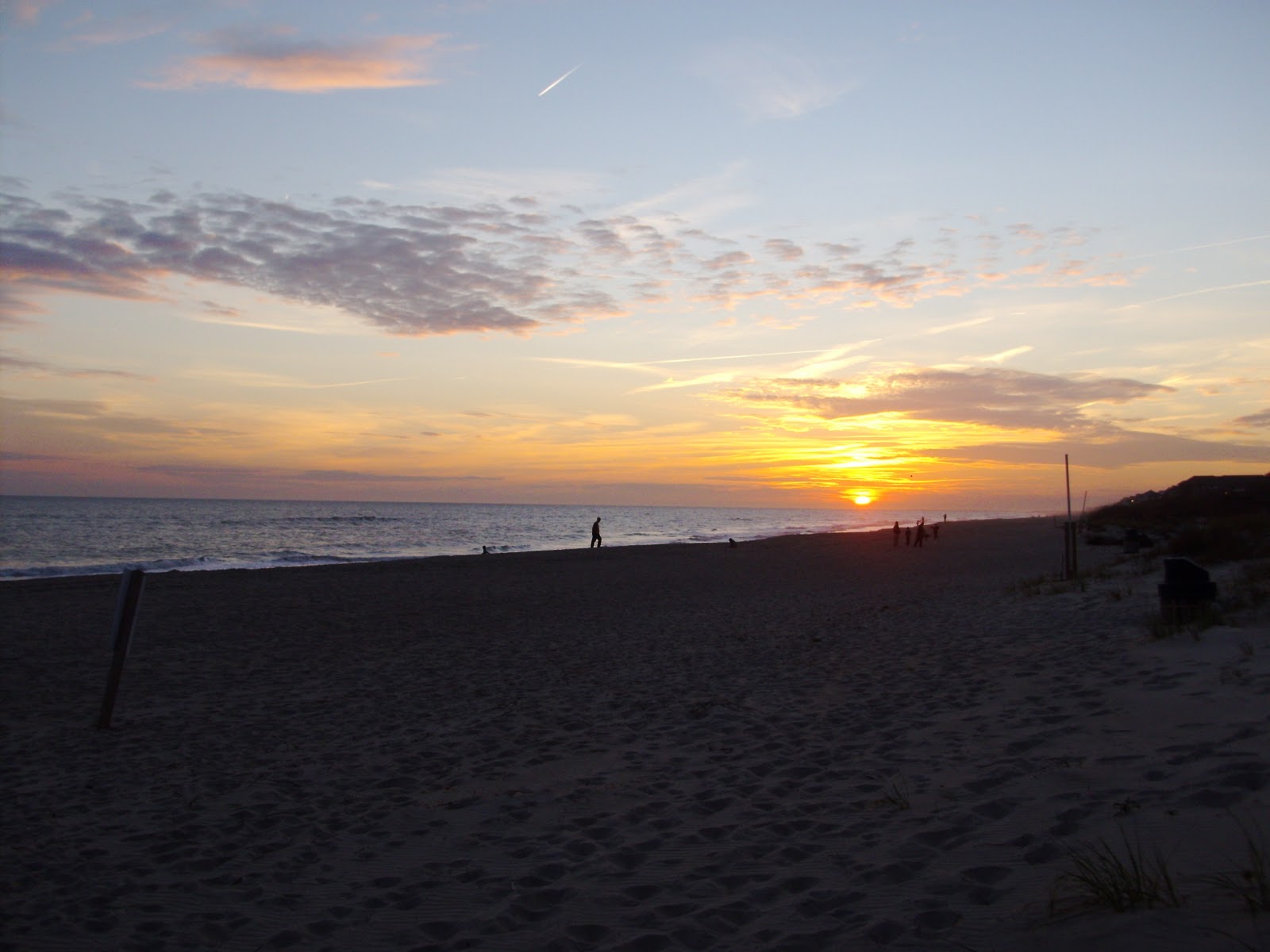
The sunset speaks for itself.

We ended the day with a treat reserved for vacation— television!

                                                                        The End

Saturday, January 7, 2012

A Quest for Shells

The sun was gleaming and the tide was low, so Christian and Mary and I decided to hit up some bars— shell bars, that is. Armed with plastic bags and sharp eyes, the three of us set out for a five-mile-round-trip excursion to find the biggest and the prettiest seashells. I was more along for the ride than anything else, since I’ve never been a fan of scouring the beach in search of the perfect exoskeleton. Instead I opt to stare out at the ocean, watch the tiny sandpipers chase the waves, and admire the gems that my siblings find.
Our walk took us to the southwestern tip of the narrow island, a wide beach that rippled in tiny dunes, interrupted by some of the most picturesque shells I had ever seen. The shore dipped in and out, washed with swatches of water funneled into pools as the tide crept to its low point. We poked at the giant broken conch shells, looked at the dead jellyfish with meaty tentacles, and watched the ocean and sound water meet and transform into an emerald-blue. In many ways I wished I had brought my camera, so I could take a picture to try to share the sight of the watery clouds hanging in the watery sky reflected in the watery sand. In other ways, I was glad I wasn’t trying to capture it all in a lens. How could a camera trap the sensation of warm sun and cold breeze, the ever-changing hues of the sky and sea, the salty glitter of the rippling water, the screech of gulls and the shadows of pelicans soaring overhead? 
Christian and Mary both ended up with impressive finds, from a whole sand dollar (which unfortunately broke) to a full Scotch bonnet, the state seashell of North Carolina, which we had never found unbroken before. Here’s a sampling of Christian’s collection:


We returned to the hotel room bathed in sunshine and scrubbed by the saltwater breeze. Even though I had only picked up three tiny shells, I considered the search a great success.

~Lisa Shafter
~

Friday, January 6, 2012

Beach Walks


At my request, Mary shook me awake at about seven this morning. The room was dark, the guys still asleep, but we had agreed to take a morning beach-walk together, and neither of us knew how soon the sun would be rising. I threw on some aqua shoes, grabbed a Clif bar and a bottle of water, buttoned up my jacket and was ready to go. Mary and I slipped outside into a nippy breeze and a sky that glowed with a rainbow of pastels. The distance from our hotel room to the ocean is less than a block, and we soon stepped into the fine white sand of the beach and began walking. 
After a few minutes, I pointed out a flock of seagulls far off on the eastern horizon. As Mary and I watched them, the uppermost tip of the sun leaped into the sky, a vivid pink that had us both staring for a moment until we remembered what our mother told us about not looking at the sun. Over the course of a few seconds, the massive pink orb had cleared the rim of the ocean and spilled golden light all over the water. 
Mary and I walked for a few miles, picking our way between the shells, watching the pelicans float in the waves like little brown sailboats, feeling the sun transform the world from golden to white, as the waves took on a green translucence and the ocean turned a soft marine blue. It was a good morning.
~Lisa Shafter
P.S. Here’s the blog about my morning beach-walk that I took the last time I visited North Carolina, a year and a half ago:
August 11th, 2010
A sunrise is nothing special. It happens every day, all day long, in some part of the world or another. But today I am 998 miles from home on the westerly rim of the Atlantic, which means that I have set my alarm to 6:00am in hopes of catching this ordinary phenomenon. I wake up surprisingly alert, eat two granola bars and step outside the hotel door.
The sky is the dim indigo that precedes the dawn: the color that makes nightmares dwindle into shadows. I stride down the sidewalk, past buzzing yellow lights, across the prickly grass and onto the wooden steps leading down to the beach. A damp and salty wind washes over me, making me shiver. In the minute it takes me to get from the door to the wind-painted sand, the sky has lightened. Pale pink stripes ornament the eastern firmament, promising a sunrise behind deep gray clouds. I begin to walk in that direction, toward a distant pier.
The sand clings to my feet and the waves fill my ears with a comfortable white noise of thunder and sibilance. I watch the sandpipers scurry along the tide line in a familiar routine: first they outrun the rim of each collapsed wave, their legs a blur too fast for the human eye. When the foam reached its peak and recedes, the birds dart into the shadow of water and drill for invertebrates, their beaks moving like tiny jackhammers. I see one squat in a skim of water and ruffle his mottled brown wings, starting the morning with a salty bath. 
Eventually the light begins to take shape. Wisps of cloud, the brushstrokes of an Impressionist painter, glow with pastel pink and gold. A splash of neon orange above the dark cloud-bank signals that the sun is creeping its way heavenward. In early morning, the ocean is colorless, gray upon shifting gray, but when the waves spill onto the shore, an extraordinary thing happens. The dull water transforms into a sheen of pastel sunrise, turning the whole beach into a vast glossy rainbow. In fading glory the waves light up the shore, then vanish into the sand. 
I’m almost to the pier now. It stands dark against the sunrise, hazy where the waves assault the pylons. I glance out at the waves again, then down at my feet as the   foaming water gallops over them. That’s when I feel warmth on my face beneath the brim of my crusher hat, and look up.
In an instant the sun has broken free of the dark mist, a hazy golden-orange globe hovering between two cloud-banks. Despite all my mother’s warnings about going blind, I find myself staring at first the orb, then its twin reflected in the backwash of the waves. I am silenced, eyes burning with the light. Before my retinas wither into ash, a shroud of the dark clouds billows over the sun again. I’ve arrived at the pier.
The corridor between the algae-stained wooden pylons has always reminded me of a magical tunnel from a fantasy world: it seems a narrow slice of the ocean, with waves forming out of nowhere to pummel the manmade structure. It’s a wonder that the crudely-carved wood can withstand the force of a body older than the world itself. I glance left and see a solidly-built man in his thirties wades beneath the pier, holding a metal rod with interlocking metal triangles on the end, forming some sort of stiff net. I ask him what he’s catching. “Sand fleas,” he says. “Cool,” I reply. “What are sand fleas?” He points to a bucket nearby and I look in to see a heap of what my family calls sand crabs, or sand fiddlers.
“Sand fleas” or “mole crabs,” as they are often called, seems like an unfair name for such pretty little crustaceans. Averaging the size of half a thumb, sand crabs’ shells are almond-shaped, gray with all sorts of color variations from subtle dark mottling to pastel purple and pink. Their pale legs stay tucked under their bodies, and tiny heads sport translucent eyes the size of pinheads, mounted on stalks. My sister taught me to catch them by watching the wet sand in the wake of a retreating wave: if the sand appears softly crosshatched, as if scored with many tiny Vs, then it’s probable that the crabs are burrowed beneath the surface, tiny eyes poking out to wait for the next wave. I’m fond of spotting their hideouts and delving my hands into the sand around them, letting the waves wash away the excess. If I’m lucky I’ll be rewarded with two palms-full of wriggling marvels tickling my fingers. I always let them go quickly, dropping them onto the tideline, where they burrow backwards and disappear into their habitat.
I take my leave of the crab-hunter. Noting a golden rim on the uppermost dark cloud in the east, I decide it’s time to turn back, since I’m not wearing any sunblock— I dare not face the ocean sun without protection. I turn and walk out of the thin shadow of the pier, gazing out at a chalky blue sky to the west. A few distant cumulus clouds give the horizon some flourish, but otherwise it is hazy and unbroken. I walk quicker, splashing through the shallows as the tide crawls up the bank.
The first sign that I should look behind me is the warmth on my calves, then the clear definition of my shadow stretching across the sand. I turn. The top half of the sun peers across the cloud-bank, simmering in gold so intense that my eyes feel scalded. The shape of an orb can’t contain the light: it spills out onto the clouds, pooling like liquid, ready to break its banks and flood the skies. A stillness overtakes the world. The waves grow muted; the sandpipers pause. Weeping has remained for the night, but I know what the morning will bring. I hold my breath.
With one final shimmer of suppressed joy, the sun breaks free of the cloud-bank. Sunrise. The clouds burst into flame. A column of light, shimmering like the heavenly host, in an instant pours down the receding waves and rushes over me. Just before I am overwhelmed and blinded, I catch a glimpse of the sky and ocean as one, a tapestry of molten gold.
With stinging eyes I turn away, blinking away the purple blotches swarming before my eyes. The sandpipers skitter along the shore, then take flight over the golden ocean. I am staggered, confronted by transcendent beauty that has swept along the rim of this planet from the moment God charged the sun to bring us daylight. Feeling small and unworthy and unspeakably blessed, I hurry back along the beach to the safety of my room.

Thursday, January 5, 2012

Arrival

Today, after eight hours of on-and-off driving, we reached our hotel on the beach of North Carolina’s Outer Banks. We stretched our cramped legs, checked in, and ran barefoot down to the water. The sand was freezing, and we ran back up pretty soon after, our feet numb. I put on shoes, we threw our luggage into the room, and then we headed back down, this time all wearing some sort of foot attire. Then we were able to appreciate the beach in its fullness.
The moon is waxing toward fullness, so bright in the clear night that she cast distinct shadows on the sand. We walked out on fine sand and gazed up at the stars. Since this is “off-season,” more than two-thirds of the beach houses are unoccupied, so their windows are dark and the beach is much darker, showing off the backdrop of night sky more dramatically. Over the water in the east, Orion was rising, his three-starred belt glimmering in the salty air. The ocean churned and peeled over itself and foamed, unending, immovable. At nighttime it seems especially sentient: the moon on the curling waves gleamed like light on the hide of a sea monster. These dragons flickered in the water, turning their black sides to the moonlight, then flipped over to reveal a long dorsal fin of foaming white before vanishing into the tide. We walked a couple miles, out to the pier and back, the cold air settling on us like dew. 
Now I’m back in the hotel room, exhausted (I keep forgetting that I’m still recovering from being sick for two weeks) and ready to curl up in bed. I’m glad to be at the ocean. I’m glad we’ve made it safely.
~Lisa Shafter

Wednesday, January 4, 2012

Midwest to East

The past two days have felt a bit surreal. I’ve observed everything through a haze of pain as my body reminds me every few seconds, with a shocked expression, that oh my gosh your wisdom tooth is hurting! Despite that, I’ve managed to have a good time. I generally sit in the backseat, couched between the door and my backpack, with Christian poking and bugging me as he has been doing since I was born. I have my staple snacks: almonds, apples, and ingredients for PBJ, as well as some extras such as pretzels and chocolate. The weather everywhere we’ve gone has been cool and bright, with intense sunlight that paints the world in vivid orange. I’ve enjoyed the winter landscape— trees, shapely in their bareness or feathery in their numbers— and the terrain that has transformed from the quilted flatness of the Midwest to the rolling foothills of the East.
Best of all so far has been the time we spent with my relatives. This morning our “Poppi” and “Nonni” (my dad’s parents) fixed us a down-home breakfast, complete with sausage, bacon, biscuits, and scrambled eggs. We didn’t have much time before we had to hit the road, with a full day of driving ahead, but it was good to see them.
Now the four of us are hanging out in a cheap but clean hotel to the eastern side of Atlanta, watching River Monsters Unhooked on the tele. I’m tired and still in pain, but I’m happy to be on the road again.
~Lisa Shafter

Tuesday, January 3, 2012

Off to North Carolina

It’s time to hit the road again! After almost five months of being at home, today I’m packing up two backpacks and getting ready to pile into a car with three of my best friends: my siblings Mary and Christian, and our long-time friend (and Mary’s boyfriend) Ryan. As often happens on my trips, I’m not feeling the best today: one of my wisdom teeth is coming in, which has swollen up the side of my mouth down my throat. Still, I’m excited to be hitting the trail in a few hours. We’re first going to visit my grandparents in Indiana, and then tomorrow we set out in earnest, ending up on the outer banks of North Carolina. The sun is out, the sky is sharp, the air is brisk, and it’s the perfect day to begin a road trip.
~Lisa Shafter

Monday, January 2, 2012

Lists

"God put me on this earth to accomplish a certain number of things. Right now I am so far behind that I will never die." ~Bill Watterson
I have always been a list-maker. I come by it honestly— when I was a kid I considered it a great privilege when Mom would let me cross off something on her list (there was a special technique to it). When I was 14, I heard the head of a department at a tech school explain his way of scheduling: “I have a list of things to do, but they’re in order of priority. Something that was #37 yesterday might be #1 today. It’s constantly fluctuating.” His statement opened my eyes, and made me realize that someone else thought about tasks in the same way I did.
On any given day, I have a list of 10-15 things that I want to accomplish. I order them by priority and see how many I can get done. If I only finish three items, as long as they were priorities, I still consider the day a productive one. That’s the key to list-making: you can’t stress out about finishing everything. Otherwise, you’ll just drive yourself mad.
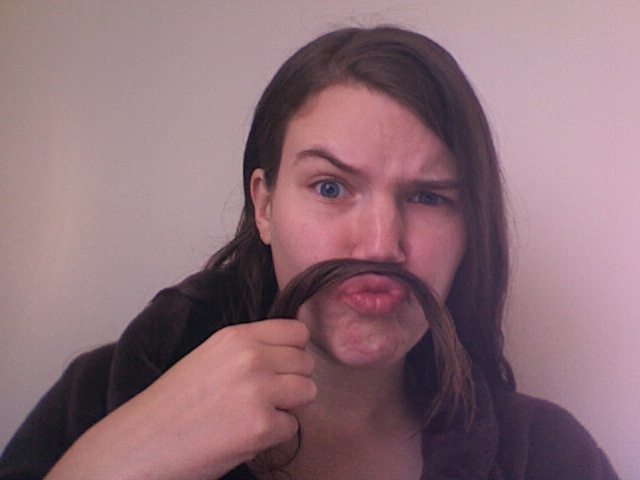
Growing a mustache is also on my bucket list.
I have quite the bucket list for life— leave footprints on all 50 states, raise a family, do a book tour, become an established travel writer, build a haven for travelers, and visit the seven continents, to name a few— but if at the end of my years I haven’t accomplished all of them, I won’t feel too disappointed. Doing something is better than nothing, and I make a conscious effort to do something every day. If you set your sights high, even if you fail you’ll still be further up than if you didn’t try at all.
~Lisa Shafter


Sunday, January 1, 2012

Three Questions

What will you do that is meaningful with this new year?
How will these actions show who you are or who you wish to be?
What chances will you take?