Showing posts with label north carolina. Show all posts

Friday, August 26, 2016

Happy Birthday, National Parks! (Part One)

I totally missed the National Park Service Centennial yesterday— whoops! Well, Happy Centennial to our national parks a day late, and also Congratulations to all the Park Service people who keep these national treasures up and running!

I’m grateful that I’ve gotten a chance to visit 12 national parks in my lifetime (seven of those while hiking the Pacific Crest Trail), and hope to visit many more in the future. I’m proud that America has worked together to preserve these areas for generations to come. In honor of the centennial, here’s a run-down of the parks I’ve visited and why I love them:

Great Smoky Mountains, every year for most of my life. On my family’s yearly vacations to visit my grandparents in North Carolina, the Smokies were our go-to camping spot. We’d always camp by a creek so us kids could try to catch minnows, skip rocks, and cool off after a long day of hiking to waterfalls. At night, storms would blow through, rattling our tent, and we’d tell goofy stories to entertain ourselves. Some of my fondest childhood memories are here.

I don't really have any good photos of them, though...

Everglades, 2011. (I forgot to put this in my first draft!) I had the privilege of visiting the Everglades both in the daytime and at night, which are experiences I’ll never forget. Walking along the trail, I watched ‘gators strewn across the grass like stone statues. Herons stalked in the shallows, cormorants perched on the railings, and I looked out at the grasses standing knee-deep in clear water. Also, I spotted a Purple Gallinule, which had been on my bucket list since I was a kid. At nighttime, we shone our flashlights on alligators drifting beneath the boardwalk, then hiked through the forest, watching weird green fireflies. Simply incredible.  


Zion Canyon, 2011. My couchsurfing/HelpX hosts in Salt Lake City took me to Zion while I was staying with them— I had dreamed of visiting since I was a kid, and the landscape was unlike anything I’d ever seen! I hiked to the top of Angels Landing despite my fear of heights, which was an accomplishment I’m still proud of.


Looking off the edge of the cliff at Angels Landing

Grand Canyon, 2011. The Grand Canyon was everything I hoped it would be— vast beyond comprehension, beautiful beyond description, alien and incomparable. I couchsurfed with a host who had an RV, and we spent three days hiking, crashing a party for Canyon employees, and watching the sun set and rise over the North Rim. Zach and I hope to hike to the bottom someday.


Petrified Forest, 2011 and 2012. This eerie desert landscape, once a swamp full of trees, has a haunting feel to it that is both unsettling and fascinating. Located roughly in the middle of nowhere, this park is dazzling both in the details (fragments of petrified wood, huge cross-sections of logs scattered across the sand) and the landscape (the painted desert is exactly what it sounds like). Definitely worth the stop if you’re in the area.


Zach and I hiked this path that snakes through "the pyramids."

Redwood, 2012. Zach and I visited here together, hiking a loop through these ancient, impossibly huge trees and along the coast. Near the end it got dark, and I remember a breathless speed-walk of the last mile or two, winding our way through the moss-drenched forest. (I’m honestly not sure if we were on state park or national park territory for that particular hike, but close enough!)


Tomorrow I’ll tell you about the seven we hiked through on the PCT!


~~~

Wednesday, April 18, 2012

My Favorite States

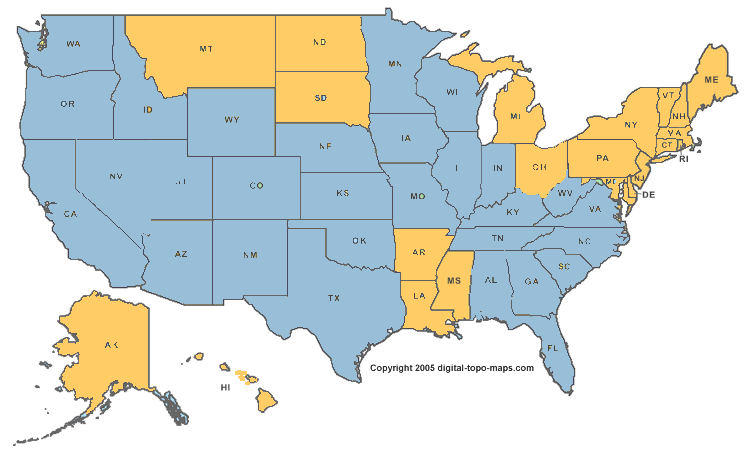
Why, you ask, have I not visited Arkansas? I'm still trying to figure it out…

Over the past two decades, I’ve been fortunate enough to visit 29 states. I consider this to be a fair accomplishment, although I still have quite a few to go to reach my goal of all 50. You may ask, “Out of all the states, which one is your favorite?” The answer is, without hesitation, “Missouri.” Yes, I know that’s cheating, but it’s true. It’s central, simple, pretty, and my home.
(You might also ask what is my least favorite. I would say, “West Virginia,” for absolutely no reason other than that I get negative feelings every time I hear those words. Am I weird? Yes I am.)
However, if your question is, “Out of all the states you don’t live in, which is your favorite?” I can handle that, as long as you allow me multiple answers. Keep in mind that these are my favorites… not necessarily the best.
Honorable Mentions:
Florida. From the Everglades and the crazy-awesome subtropical trees to Disney World and the wildlife, this place deserves to be a tourist destination— but only, I contend, in the winter. (Also, it contains the Everglades International Hostel, a truly magical place.)

If you get a chance to visit the Everglades National Park, do it.

Colorado. Home to some of the loveliest towns I’ve ever visited (Colorado Springs, Fort Collins), this state also boasts some fantastic geological formations and down-home streams. Oh yeah, and there’s also the Rocky Mountains.
This is the best shot I could find— although I've visited CO three times, I have no good pictures of it!
California. I could give a laundry list of places I love within its limits: San Diego, San Francisco, the entire coast, the Redwoods, the landscapes, the Sierra Nevada Mountains, and so on and so on. Seriously, do you need me to tell you why California is awesome?
I love the scenery around San Luis Obispo.
Now… The Top Three!
Oregon. For several months I harbored a grudge against this state, refusing to believe that it was as wonderful as all the Oregonian snobs said it was. But after being assaulted with stunning natural wonders everywhere I went, from the Columbia River Gorge to the Bandon beach, I realized that I could not deny that this place is pretty much amazing.
A sight to convert even the most stubborn skeptic.
I'll never get tired of Bandon beach.
North Carolina. From the majestic Smoky Mountains in the west to the shimmering beaches in the east, this state has a variety of vistas (and some of the most beautiful Southern accents I’ve ever heard). I love the history of this area, and little details such as tin-roofed buildings and Spanish moss. My ancestors first moved to North Carolina from Europe in the early 1600s, so I have deep roots there as well.

I love walking through downtown New Bern.
Bogue Inlet Fishing pier— my favorite pier.
Washington. This will always be my second-favorite state, if only for nostalgia’s sake. It was my first place I visited out west, the first place I saw a snow-capped mountain, the first place I traveled solo, and the first time I fell in love with a city (Seattle). I love the mix of manageable scenery (rolling hills, small mountains, streams) and breathtaking views (the Cascade Mountains, the Pacific Ocean). Also, Bellingham and the San Juan Islands are two of my favorite places on earth. 
What are your favorite states?

Lost Lake near Bellingham, Washington. Mary and I almost got lost finding it…
The view of Seattle from the ferry is fantastic— and, if you're coming from the west, free!
~~~

Saturday, January 14, 2012

Back from Carolina

The last few days have been a whirlwind of final goodbyes to the beach, Carolina pines, antebellum towns, gleaming Atlanta buildings, Tennessee hills, and miles upon miles of highway rolling beneath our wheels. The last day on the beach was sunny, the water sparkling and frothing with foamy chemicals washed up by the rainstorm the night before. We walked along the shore, watched the morning take shape, and finally splashed into the surprisingly tepid water for a while. Then we were off on the road home.
We drove relatively short spurts every day, taking leisurely meals at Chick-fil-A and Subway, playing word games for hours, and following a detour so we could jump out of the car just across a state line and yell, “We’re in Alabama!” Yesterday we stopped to visit some cousins, Emily and Rachel, who I hadn’t seen in at least fifteen years. As with the other family I’ve re-met over the past year, we got along easily. I played with their kids (and the amazing toys), ate a yummy supper Emily made us, and stayed up late with an intense game of Scattergories. This morning, Emily sent Mary and me on our way with a massive bag full of clothes to try on. 
Although I’ve enjoyed this trip immensely, I felt the tug to be back home. It hardly feels like we’ve been gone— it’s been a year and a half since I’ve taken a trip of this length, so it flew by. However, I know that I’ll be heading right back out in ten days, and for much longer (in fact, I don’t know how long I’m going to be gone on my trip to California and Oregon). I want to spend time with my parents and friends and brothers before my sister and I take to the air toward the west coast. The drive today felt long even though it was only about seven hours. I listened to a lot of music and looked at the atlas to see where we were. Midwest landscape flew by. The sunset glowed over snowy cornfields and through the black silhouettes of trees, framed by the branches like a stained-glass window. At last we pulled up to my driveway, where I saw Christmas tree lights blinking in the living room. We all piled out of the van and spent the next few hours swapping stories and showing off shells. I’m tired in the way that makes me want to snuggle down into my own bed and savor the feeling of sinking into sleep.
It was a very good trip.


~~~

Wednesday, January 11, 2012

Tourists in New Bern


Yesterday, we took advantage of the quickly-clearing weather to take a day trip to New Bern, a place that we visited a lot when I was a kid because my grandparents lived there. We still have relatives in town, and we met with my aunt and uncle at Smithfield’s and caught up over heaps of Eastern Carolina barbecue, hush puppies, baked beans and fries.

Perched at the confluence of the Neuse and Trent rivers, New Bern was settled by Swiss and Germans in 1710. Today, it’s a historic area with a pretty downtown area marked by churches, tasteful tourist shops, blossoming trees and southern mansions. We parked the car near the square and walked around, past stores selling teddy bears, home furnishings, seashells and pilates lessons. Old holiday decorations lingered in the windows, including an elaborate mural featuring excerpts of Dickens’s A Christmas Carol. Our first destination was the waterfront of the Neuse River, which looks more like a bay from its still waters and seashells we could see through the clear water. We wandered along a walking path next to a yatch harbor, then emerged at Union Point Park and strolled by the water, solid blue under the sky.
As Mary and Ryan watched the dozens of birds bobbing on the water and fluttering through the air— herring gulls, mallards, coots, and hoards of pigeons— Mary said, “I wish we had some bread.” A minute later she glanced over the boardwalk and saw a loaf of stale bread floating by the shore. We all said she should have wished for a million bucks instead. C’est la vie. At any rate, the magical bread provided a lot of entertainment for all of us. 
No trip to New Bern would be complete without a visit to the birthplace of Pepsi-Cola. I don’t usually drink soda, so I just sat with the others in the café area and watched a documentary of Pepsi’s history, beginning in 1898 with the tagline “Pepsi-Cola: Delicious. Healthful.” We chatted with the help for a while, and they recommended us to the perfect place for dessert: the Cow Café. The ice cream was all homemade, with bovine-themed flavors such as “Cowpachinno” and “Almoond Joy.” I bought a double-decker cone of chocolate “Gooey Cowphooey” and “Peanut Udder Cup.” Anyone who’s ever worked on a dairy farm would gag at the thought, but I, a city kid who has never milked a cow, ate the ice cream with abandon. The guy at the counter gave us heaping servings, too. We tipped him well.
A search for the post office led us to another part of the waterfront, where a wetlands restoration project was in effect. We strolled across the boardwalk and watched a flock of coots dabbling around nearby as the sky took on pre-sunset colors. It was a relaxing afternoon of tourism, and I went to bed content with where I was and how the day had gone. 
~~~

Tuesday, January 10, 2012

An Excursion for Fish, History, and Pizza

1/9/2012
The Pine Knoll Shores Aquarium was good when I was a kid, but now it’s great. As I mentioned yesterday, the aquarium features a range of North Carolina native creatures, from the mountain streams of the west to the offshore ecosystems of the Outer Banks. When the four of us arrived around noon, we found the parking lot nearly deserted, which promised a much more relaxed experience than we ever got in summer or spring.
We read about mountain streams and the creatures that inhabit them, playing “find the frogs” in the little tanks, and ended up by the large river otter tank, which gave underwater views of these sleek mammals. On land they walk with a ridiculous bobbing, as if their midsections are too long for their legs, but once they jump in the water they transform into creatures of superb grace, slipping through the water in a flurry of silver bubbles. One of the three otters loved swimming upside down, flipping himself over with a kick of his back paws before diving to the bottom. We watched them for a good half hour before moving on.
The journey of water continued— from mountain streams to estuaries, grass flats, and saltwater marshes. We took a brief detour to walk outside and view some of the surrounding nature area. The water, at low tide, exposed the mud and tidal grass down to its roots. A few snowy egrets perched on the dead trees nearby, and we watched the tiny minnows swimming in the inches-deep water. Chased inside by the cold, we continued our journey.
Another highlight was the stingray and guitarfish petting area. The last time I had been there, it was a crowded August day, and the poor rays were clustered to the inner part of the tank, buried in the sand, begging with every ounce of their flat-fish bodies that the tourists would go away. Today, however, they swam freely, swooping by to investigate our hands. One of them even took a liking to Ryan. I have always been fascinated by rays, and I took a special interest into the guitarfish, who looked like a sandy, mottled fish that had been run over with a steamroller. They felt bumpy to the touch, while the rays felt smooth to the point of slimy. We chatted with the keeper, who told us that rays have an excellent sense of sight. I crouched down by the glass and looked one in the eye. I wondered how he perceived me, and if I was as fascinating to him as he was to me. 
We also got the chance to pet some horseshoe crabs, creatures of another eon, as well as hermit crabs and whelks. Fascinated, we looked at the displays of seahorses, pipefish, reef-fish and jellies. In good time, we reached the 306,000-gallon tank with the 65-foot-long viewing window. The water alone weighs over two million pounds, and a keeper informed us that there are over 800 creatures in the tank. We sat and watched the schools of fish the size of my torso, the clusters of smaller fish darting in and out, and the massive sharks— nurse with their tiny blank eyes and sand tigers with their open-mouthed stare and protruding teeth— drifting through. A green moray eel, six feet long, lurked in a corner and snaked out occasionally with mouth agape to impress the visitors. After a few minutes, we were surprised to see three divers enter the tank, floating in among the sharks to check… something (we never did figure out what). They waved at us, and Ryan played a game of paper-scissors-rock with one.

From the massive tank, we moved to displays highlighting the life on the miniature reefs that form on wrecks and piers (North Carolina’s coast is too sandy to support a true coral reef). I watched some jellyfish, fascinated by their tentacles, thin as strands of melted cheese. It looked as if the slightest touch could break them, yet these creatures— with no brain or heart— withstand the power of the ocean. 
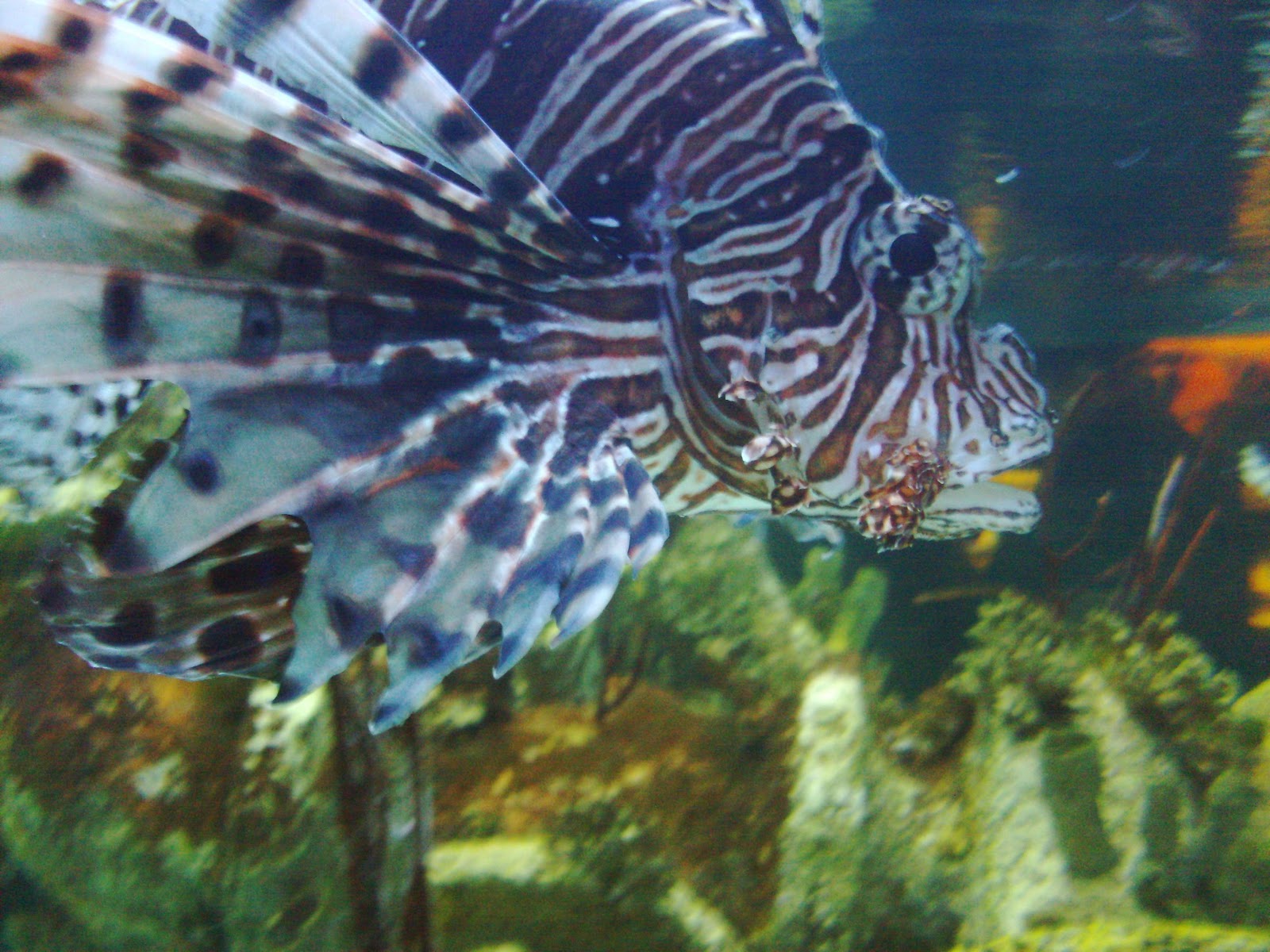
Next I turned to admire a display featuring five lionfish, venomous fish with leafy fins and tiger-like stripes (was the name “tigerfish” already taken?). I followed one around the circular tank, watching his fins, intricate as leaves, move the water to let him propel forward. The delicate movement of his gills fascinated me. Mary came up beside me and I started to say, “They’re so beautiful.” As I spoke, the lionfish’s tail fin drifted right past my eyes. I caught every detail of that moment: the fine brown ribs, the translucent webbing as delicate as spiderweb, the dark spots like drops of acrylic. My last word choked, and I felt a sob of joy rising in my throat. Just yesterday, I had been sad that I don’t feel things as deeply as I used to. But joy comes at unexpected moments, even in lionfish fins.

~


I didn’t want to go to Fort Macon. It was raining, and as far as I remembered, there was nothing to the fort except a shell of a brick building in the earth with nowhere warm or dry to sit. But I was outvoted three to one, and it’s a good thing I was. Not only was the fort full of indoor rooms with heating (I had forgotten the fort was closed last time we visited), but also contained interpretive displays, informational plaques, several creepy mannequins in Civil War uniforms, audio monologues about history and everyday life, and a video about the fort’s history. A veteran of three wars— the War Between the States, the Spanish-American War, and World War II— Fort Macon has been restored to a place where the memory of life in the 19th century is kept alive. 
The Confederates “captured” the fort in 1861 (really, they just marched up to the gates and told the single, unarmed caretaker to move to Beaufort) and held it for a year before the Union came to take it back. After a siege in which the Confederates were hopelessly outgunned, the 27-year-old commandant of the fort, Colonel Moses J. White, surrendered. There was a picture of him in one room. Clean-shaven, long-haired, with a handsome face and the hunted look of someone dealing with an untreatable disease (his epilepsy took his life two years after the siege), he looked like a man that I would like to meet someday. He seemed like a true Southerner, graceful, dutiful, and full of pride. 
As much as I admit that the Union winning the Civil War was a good thing, my heart always softens to the Confederates. I know these are my family roots, running deep into North Carolina and Virginia. I imagine my ancestors— poor as dirt or else horse thieves on the run from the law, as the records seem to show— sending their sons off to battle and praying for their safe return. As a child, I always thought that war would make more sense when I got older. The older I get, the less sense it makes.
Although the histories of conflict are interesting to me, I was most fascinated by the descriptions about everyday life in the fort. A display about laundry caught my attention. In the 1800s, washing clothes was an arduous task involving mending, specific sorting, a day of soaking, hand agitation and scrubbing, different chemicals for different kinds of discoloring, special handling when drying each kind of material, and the tricky technique of using an iron heated on a stove. It made me think about how much time and effort everything took just a century and a half ago. What would they think if they saw a washing machine, an electric stove or a smartphone? And how many of we modern people would not survive if we were dropped into the middle of antebellum North Carolina?

The sky had cleared a bit by the time we were finished walking through the displays, so we strolled along the top of the fort, trying to visualize where the Union cannons had been set. A chill, wet wind whipped around me, and I thought about the soldiers facing the sea and thinking of their sweethearts, their families, and what they would do when all this was over.
Safe in the warmth of the car, we trucked over to the mainland and found a Pizza Hut. As I chomped down on the Pepperoni Lover’s with extra cheese, I didn’t think about how long it would have taken to make this in the 1800s. My modern brain had taken over, a brain that consumes without thought, that has no connection to source of anything, be it food, supplies, or electronics. Now, back in the hotel room writing this blog, it makes me think. If I could live for a day like those in the Civil War, just a day, what would I learn?
~
Yesterday was a day of knowledge, memory, delight and open-eyed wonder. It was a reminder of the beauty of creation, the hardship of life, and the breathtaking details that make everything worth learning.
~~~

Monday, January 9, 2012

The Extraordinary Ecosystem

Something that has struck me over the past few days is the marvel of the ecosystem. Here is a habitat, a base set of rock and earth and weather and water, and here are the animals, plants, and microorganisms that thrive in it. All nature within this setting is adapted to its surroundings, and everything is connected to each other in breathtaking ways, a never-ending web of life.
Here is a whelk, a kind of sea snail that hunts clams and other smaller invertebrates. A seagull catches the whelk and eats it, leaving the shell behind. A hermit crab moves in for a year or so, then leaves the whelk to the waves. The shell is smashed by the waves upon the shore, drawn back, and smashed again, until it joins the beach as a grain of sand. A seagull dies, the other seagulls scavenge his flesh, and the ocean reclaims his bones and crushes them to sand, to join the remains of the whelk and the hermit crab and millions of other invertebrate leftovers, which are filtered by the bottom feeders, such as stingrays and guitarfish. Everything works together in a system that checks and balances and sustains the ecosystems for eons. 
It’s no wonder that environmentalists and conservationists work so hard to avoid significant changes to a habitat— one difference can upset the entire balance. However, these well-meaning scientists spend a great deal of their time telling people, with a vaguely threatening tone, that human interference always leads to destruction and death. Some of them imply, or say outright, that the world would be much better off if humans were not part of it. This is, of course, nonsense. If you’re an evolutionist, you believe that we are part of nature, so it’s our job to coexist with our fellow animals and continue to survive. If you are a creationist, you believe that we are stewards of the earth and should take care of it because God’s creation matters to Him. Either way, our goal should be to help the earth thrive— because when nature flourishes, so do we.
Today, the four of us visited a the aquarium, which leads visitors on a path starting with exhibits about wildlife of western NC, moving through a variety of displays until reaching a 306,000-gallon tank filled with fish of all kinds, including several sharks and a six-foot green moray eel (I will devote another blog to our visit). We took our time, giving me a chance to read the informational signs as well as watch the fish (and river otters!). 
Something that struck me was the variety of habitats that have been created by human interference: new ecosystems have appeared in reservoirs, piers, drainage ditches, and shipwrecks. Here were blatant examples of humans altering an ecosystem… and creating a new habitat for life to blossom. Humans affect our surroundings in different ways, but if we are wise, nature finds a way to fit in. The key is variety. Small ecosystems can eke along in a suburb of neatly-clipped lawns and saplings, but they thrive in a neighborhood of gardens. I firmly believe that the future of farming, and living conditions in general, is in permaculture: the idea that a farm or house/neighborhood should be an ecosystem to itself, a habitat where food and animals can grow in a way that is organic and harmonious. It’s based on the idea that we can take care of the land, as well as ourselves.
Habitats change, areas develop, ecosystems get caught in the middle— but human interference doesn’t have to have negative impact. If people can learn to be thoughtful of nature, rather than worshipping it or disregarding it, ecosystems will thrive everywhere. Every attempt we make to create an ecosystem, no matter how small, is a step in the right direction.
~~~

Sunday, January 8, 2012

Beach Day: a Story (Mostly) in Pictures

Once upon a time, I woke up to a warm sunny morning in January. It was the beginning of a perfect day.

After separate beach-walks, the four of us met up to go make sandwiches for lunch.

The couple who took our picture were feeding the seagulls cinnamon bread.

They gave us some bread so we could join in on the fun.


Can you tell that we're sisters?

We decided we wanted to take a "Po' Bear Plunge" into the frigid water.

Afterward, we couldn't feel our limbs, but we look pretty warm.

Ryan grilled hot dogs for supper, and we had a picnic.


Afterward we shivered in the evening breeze while eating popsicles and ice cream sandwiches.

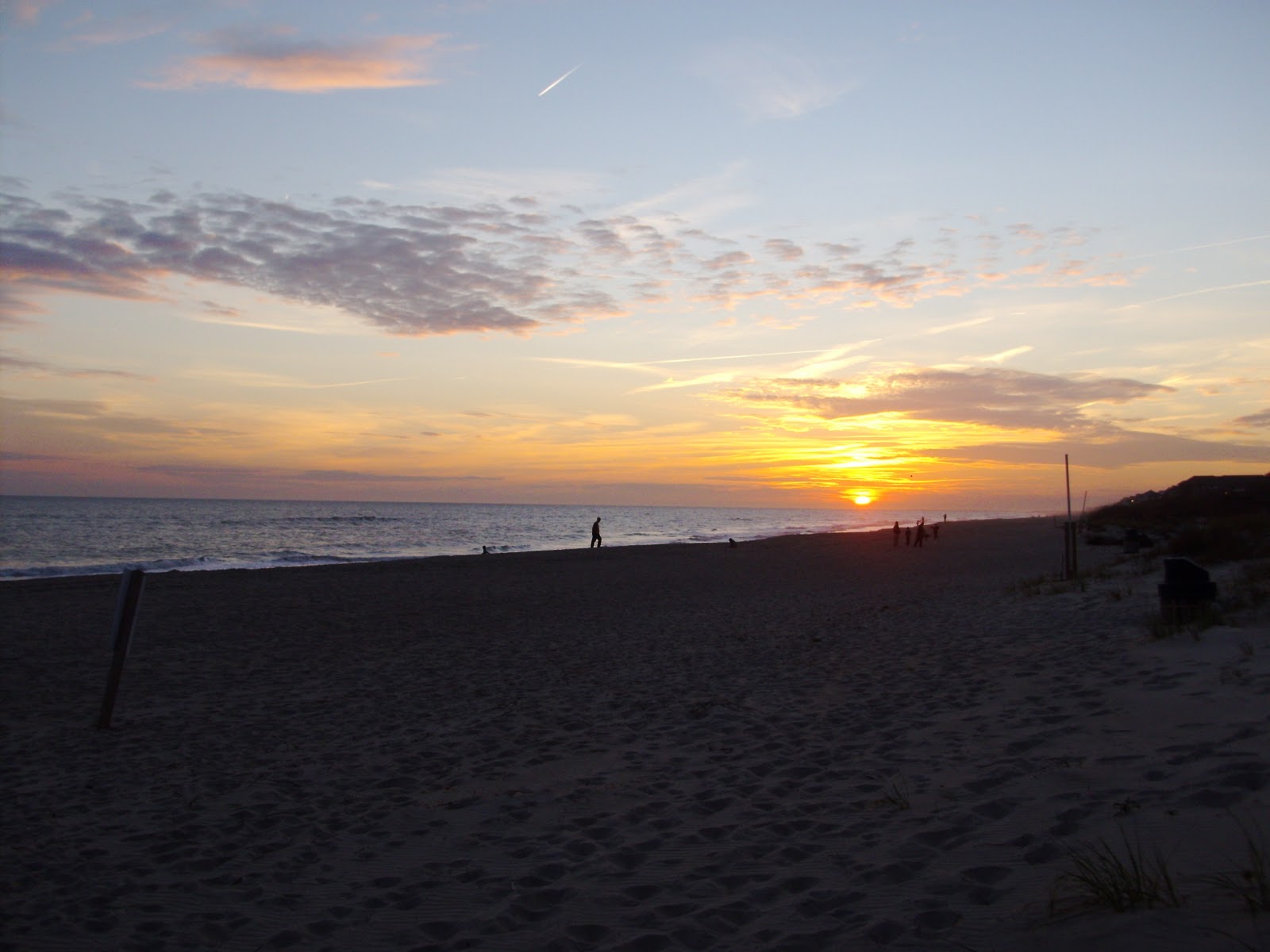
The sunset speaks for itself.

We ended the day with a treat reserved for vacation— television!

                                                                        The End