Showing posts with label grand gallivant. Show all posts

Tuesday, September 12, 2017

The Grand Gallivant, an Epilogue: The End of the World


First of all: you need to check out this album. Created by my friends Tyler, Adrienne and Amanda (with contributions from several other people, including me), it is the perfect encapsulation of how I feel about the west and the apocalypse.

~~~

It’s easier to believe in the end of the world when you’re out west.

Whether you’re staring into a pit of boiling mud so alkaline that it could melt your skin off Raiders of the Lost Ark-style if you fell in, or hiking underneath a 6-million-pound boulder perched on a slender neck of sandstone you can scratch with your finger, or coughing through the smoke of several million acres of forest up in flames, or simply riding along the empty hills— miles upon miles of scrub and sand and stone— with no food or water in sight, it’s easy for your mind to wander toward thoughts of destruction and chaos and the end of all things.

You see a pronghorn antelope trotting through the sagebrush; all the giant predators that hunted it during the ice age are extinct. You see a mountain meadow; a mile-deep glacier scraped over it eons ago, scalping the landscape down to bedrock. You see an interesting rock formation along the beach; a volcano spewed them here and heated them into jelly. The earth has been through so much violence, so much upheaval. What makes us think that we, with our little human inventions, could be safe from something at the scale of nature? All of Yellowstone is a sleeping supervolcano, and it won’t sleep forever. 

“When Yellowstone blows up,” Kate told me at the farm in Idaho, “Billy and I are getting in our truck and driving toward the light.” 

It doesn’t sound like a bad way to go.


Right now, much of the country is on fire, and some of it is underwater, or soon to be underwater. I look at the pictures wide-eyed: as much as I love the idea of resilience and self-reliance, all the canned goods and garden systems in the world can be swept away in a moment and smashed.

Yet here I am at my home in Missouri, balanced on top of a fault line, my house protected from the longest river in North America by a six-foot wall of dirt, and I put black-eyed susans into a mason jar because I think it looks pretty. The familiarity of Missouri keeps my mind safe from the apocalypse of the west. The cornfields protect me from the end of the world even as they cause it.

The sky is full of smoke, the earth is full of water, and I’m caught in between, trying to live life as best I can.

If I knew the world would end tomorrow, I would plant a tree today.

Keep planting trees, everyone. 


~~~

Friday, September 8, 2017

The Grand Gallivant: In Summary

When we returned home, people asked us the Question: “How was your trip?”


“Good,” I would blurt out. “Fun. We learned a lot. There were goats.” Goats are relatable. Most people are content with this answer, and we can move on with our conversation.

As usual, I have a laundry list of places we went— national parks, farms, visits with family— and things that we learned— basic spinning with cashmere, beekeeping, farm management, cherry-juicing, wine-making, four-wheeling, basic acro-yoga, raising meat chickens, plus all the workshop topics at the Mother Earth News Fair— but these are merely elements. They don’t sum up what our trip was like. But sometimes they’re the best I can do. 

This trip was certainly one of the most unusual, involving so many different elements and experiences. Some of the best moments weren’t particularly blog-worthy, such as eating freshly-grilled corn at Gary’s house while cheering on Chris Froome in the Tour de France, or walking through the neighborhoods in Vancouver talking and dreaming about what we wanted life to be like when we got home. It was beautiful, and sometimes boring, and often very intense.

I wrote this in my diary as we were headed back from our Utah trip: 

You always think trips will change you. How could they not? When you’re in the middle of picking raspberries for the first time, or toasting marshmallows with fifteen German guys, or trekking with iron legs up your hundredth mountain in a month, or holding a thousand bees on a frame in your hands, you think, this is going to change me. There’s no way I can go back to the way things were before.

Then you come home. And the house is the same, the city is the same, the people are the same (although some of them have longer hair than you remember). And in a day or two you realize that you are the same too, and it’s alarming but it’s also a relief.

When people ask you, “How did you change?”, if you’re honest with them you say, “I learned that if you push down on the tip of a banana it breaks into three even pieces, and now I will think about that every time I eat a banana.” Because it’s one of the only tangible things that you hold onto once you are home.

And you sigh, and you stop noticing that you’re still the same, and months or years slip by.

Then one day, you plant raspberries in your yard, and when the first berry ripens and you tuck it into your cheek, your memory bursts open and you’re back to where you began, and you remember who you were then and who you are now, and you see that they are the same— but as a seed and an apple tree are the same.

Coming home from a trip is a lot to process, and I feel like I’m still finding my feet. But in short, I’m so glad we went... and I’m so glad we’re home.

~~~

Wednesday, September 6, 2017

The Grand Gallivant: Zion National Park, Utah (a New Experience)


I visited Zion National Park in April of 2011, hiking the Angels Landing Trail and generally having a fantastic time. Visiting in August, we were braced for an experience that resembled Disneyland more than a national park, and we were right.

Me in 2011
Me now

To begin with, we only had half a day to spend in Zion— we had to get back to Vancouver so Zach and I could have at least one day to pack before we headed home. We drove in on the east side, taking some time to hike a trail near the entrance that offered us a glimpse into the canyon from above, before driving through the mile-long tunnel into the proper park. (We also saw some bighorn sheep grazing among the rocks, which was pretty cool.)

We were a bit crunched for time to begin with, and this wasn’t helped by the fact that there were literally no parking spots left in the the park. So we drove to the nearest town and took a free shuttle into Zion, then transferred to the shuttle that runs through the park itself, waiting in life for twenty minutes and cramming in between sweaty people, glancing at the rock formations through the skylights in the bus.


We hiked only one trail, Emerald Pools, in the main section of the park, which gave us some nice views of the canyon as we switchbacked past a series of pools. The trail was crowded with people, a constant start-and-stop of letting people pass on the narrow route. At the final pool at the top, people were splashing and wading in the fragile desert oasis, ignoring the “Do Not Swim” signs and making lots of noise. We tried to see past this to the beauty, but soon turned around and headed back.


I was disappointed that we only got a brief, tourist-packed look at Zion, but this is what you have to expect when traveling during the summer. If you ever plan to make the trip in summer, arrive early, leave plenty of time for getting around, and be at peace with the crowds.

We, at any rate, piled back into the car, bought some Fritos, and started back toward Vancouver. Our Utah vacation was drawing to a close, and it was time to head home.


~~~
Tuesday, September 5, 2017

The Grand Gallivant: Bryce Canyon National Park, Utah (and a View of the Galaxy)


Bryce Canyon has been on my bucket list ever since I was a kid, so I was excited to finally visit! As we drove from Moab through the deserted back highways, dark clouds closed over our heads, and lightning flashed in the distance. We saw a couple antelope bounding through the sagebrush away from the oncoming storm, and within a few minutes, it hit us.

The next thing we knew, we were driving through such torrential rain that we couldn’t see the road in front of us, and soon ice pellets began thundering and bouncing off the windshield, so loud that we covered our ears. Gary inched along the highway, hoping to move through the storm, but it seemed to be following us! 

At last we stopped at a Subway near Bryce’s entrance, and dashed into it— getting soaked to the skin in the fifteen feet between the car and the door— to go to the bathroom and regroup. We at last decided to drive to Bryce’s lodge and try to wait out the weather there.

By the time we walked into the lodge, wet and shivering, the rain had let up a bit, and we warmed up with some nice soup at the lodge restaurant (I highly recommend the elk chili). Then we decided to drive down the park’s main road to see what we could see.

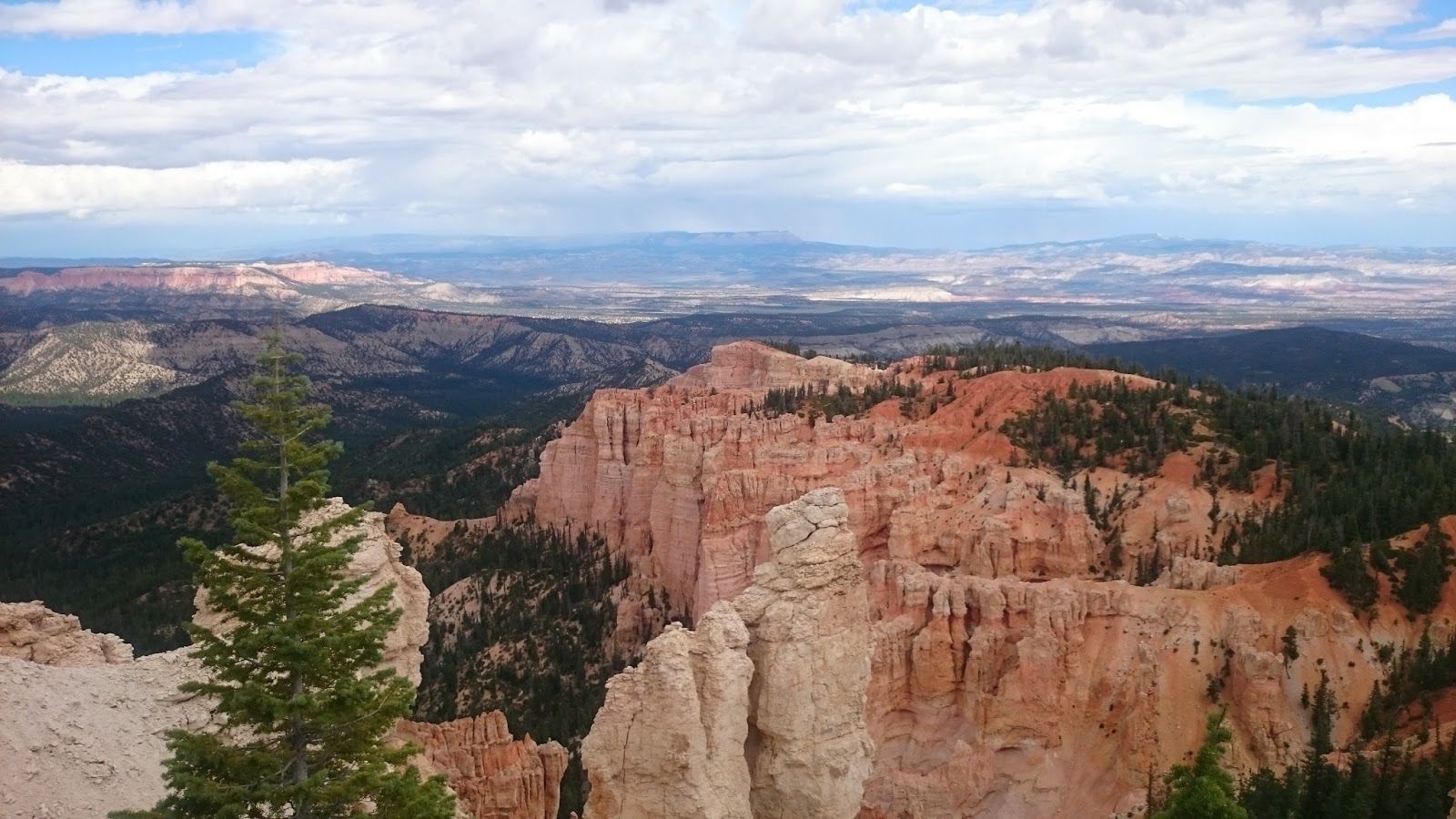
I’m still not entirely sure how Bryce qualifies as a “canyon”— it’s mostly a ridge of land that looks down into a garden of the most bizarre spines of rock I’ve ever seen. If you just drive along the single road through the park, you won’t see much: but if you park at the numerous overlooks and walk ten feet to the lookouts, you’re rewarded with views of pockets of the incredible rock formations. They seemed to glow a pinkish red under the roiling gray sky. 

I named this raven Carc.


We hiked a mile loop at the end of the road (panting to catch our breath in the 9,000+ foot elevation), then headed to our campsite for the night, a KOA down the road. Our campsite was perched on a hill, and we huddled in the lee of a tree to keep out of the fierce wind. We had hoped for a glimpse of the meteor shower tonight, but the clouds made us lose hope. Instead, we attended an ice cream social at the KOA and went to sleep hoping for better weather tomorrow.

When we woke up, we were rewarded— it was sunny but not too warm, thanks to the higher elevation. We drove toward the park to see what we could see on foot. 


Although you don’t have to hike to enjoy Bryce, we had a great time walking a trail down into the “canyon,” which wound between the spires, cut through fins and columns and balanced rocks, and ended in a grand series of switchbacks that took us straight up a narrow slot canyon called Wall Street. Seeing the formations from below was awesome! The only downside is that this is a very popular trail, and we were walking in a constant stream of people. So if you’re after solitude, Bryce Canyon during the summer is not the best choice.


Next we hiked along the rim for a while, which was less crowded and had beautiful shifting views of the “Amphitheater.” We took a free shuttle back to our car, poked around the visitor center for a bit, then headed out. 


We spent the rest of the afternoon visiting Kodachrome Basin State Park, which had beautiful columns and formations in its own right. Utah is incredible!


One of my favorite things about the area, though, happened on our second night: the clouds cleared (except in the north where the meteor shower was), and even from our campsite we were treated to the wonder of dark skies that surround Bryce Canyon. Zach and I pulled out our sleeping pads and laid down on the ground, staring up at the constellations came to life: Scorpio sprawling across the lower sky, Ursa Major and Minor hovering far above our heads, Cygnus flying and Delphinus swimming above us, Cassiopeia looming large on the horizon. But soon more stars appeared, and it became impossible to see the constellations for the number of diamonds in the sky. The Milky Way began to glow, not pure white but tinged with reddish and bluish brown, like the pictures you see from the Hubble Telescope— a three-dimensional splatter of stars. I stared at the Milky Way, and it really struck me that I was gazing into the center of our galaxy. The weight of it really hit me, and I began to cry. Stray meteors fizzled and trailed above our heads, and I felt that if this happened to be my last night on earth, with Zach lying beside me and our galaxy spinning above my head, I would be perfectly content.


~~~

Monday, September 4, 2017

The Grand Gallivant: Canyonlands National Park, Utah


I didn’t know what to expect from Canyonlands, since I had only vaguely heard of it before this trip. Indeed, it’s one of the little-visited national parks of Utah, drawing about a quarter of Arches’ tourists, according to a ranger we spoke to. Canyonlands doesn’t have iconic places like Delicate Arch or Balancing Rock to hook people’s attention— but if you visit, you’ll wonder why people aren’t flocking here in droves.

Proof that Gary did actually come along with us!


The area is divided into three main districts— we visited the Island in the Sky district, which begins with a high plateau covered in scrub and grass (it reminded me of Yellowstone), then narrows to a ribbon of land with canyons on three sides. We hiked a few trails that led us to the edges of the canyons, gaping at the geology that dropped down, layer after layer.


After a couple hikes and a ranger lecture about the geology of the place, we didn’t have time to make it down to the Needles district, which apparently has a lot of human historical sites as well as cool formations. You could easily spend two full days in this park without hiking that much, and could spend a week in the backcountry and still not see everything. 

Beware the chipmunks, though!


In short, Canyonlands is an overlooked wonder of Utah. If you’re ever planning a trip down there, don’t forget this park— it’s far less crowded than Arches, Bryce, or Zion, and just as stunning.


~~~